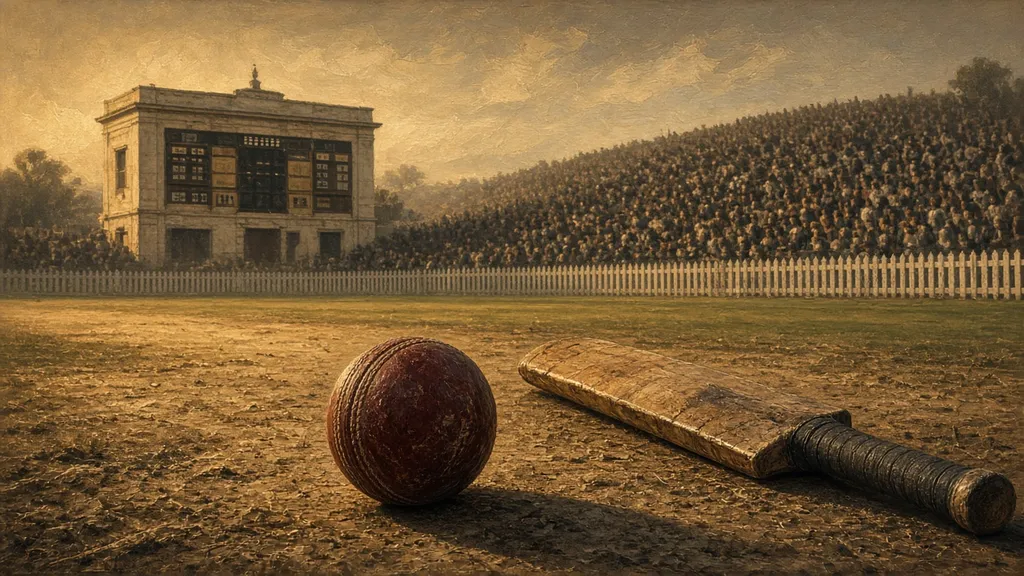
Wisden's report of the Adelaide Test of January 1933 contains a sentence that has lasted better than most things written about cricket. "Seldom, if ever, has a Test match been played under such unpleasant conditions." It is a measured sentence, and Wisden was a measured publication. It was describing the afternoon that nearly ended cricketing relations between England and Australia.
The series, so far
England had come to Australia in 1932-33 with a plan. Their captain, Douglas Jardine, and his fast bowlers, led by Harold Larwood, had decided that the best way to stop Don Bradman was to bowl at him: fast, short and on the line of the body, to a packed leg-side field. The method became known as Bodyline. England won the first Test at Sydney. Bradman, who had been ill, missed it. Australia won the second at Melbourne, and the series was level at one Test each when the teams reached Adelaide.
The third Test began on 13 January 1933. Jardine won the toss, and England were soon 30 for 4. They recovered to 236 for 7 by the close of the first day and were all out for 341 on the second, in front of a record crowd of 50,962. Leyland made 83, Wyatt 78 and Paynter 77, and Wall took 5 for 72 for Australia. When Australia batted, Ponsford made 85, but they were all out for 222, a deficit of 119. The crowd had enough to cheer about for a while, and then it did not.
Woodfull, over the heart
When Australia batted, Larwood hit the captain, Bill Woodfull, over the heart. It happened in Larwood's first over. Jardine then moved to the leg-theory field, the Bodyline field, and the crowd turned furious. It is a decision many Australians have not forgiven since.
Woodfull went on to carry his bat for 73 not out when Australia were bowled out for 193 in the second innings. Among the stories that circle that match is the one about Pelham Warner, of the MCC party, who visited the Australian dressing room. Cricinfo reports that Woodfull reportedly told him, "I don't want to see you, Mr Warner. There are two sides out there. One is trying to play cricket, the other is not." That quote is reported rather than recorded, and it should be taken that way. It has lasted because it sounds exactly like Woodfull.
Oldfield, and the third day
The second blow came on the third day. Bert Oldfield, Australia's wicketkeeper, was batting on 41 when he was hit on the head and retired hurt, his skull fractured. By Cricinfo's account it was a conventional delivery, which Oldfield top-edged into his own head, and he said afterwards that it was not Larwood's fault.
That did not matter to the crowd. They had seen their captain struck over the heart, and now their wicketkeeper was carried off with a fractured skull, and the sound that came from the ground was the sound of people who did not care what the technicalities were. Cricinfo's own account of the afternoon is headed, with no exaggeration at all, "A near riot at Adelaide Oval".
The cables
On 18 January the Australian Board of Control sent a cable to the MCC at Lord's, protesting that the bowling was unsportsmanlike. The MCC replied on 23 January, rejecting the charge. The Prime Minister, Joseph Lyons, then became involved, which is not something that ought to happen to a game of cricket. The Board withdrew the charge before the fourth Test.
The match itself had ended with England winning by 338 runs. Jardine had scored 56, and Hammond 85 and Ames 69 in England's second innings of 412. Larwood took 4 for 71 in the second innings, Allen 4 for 50. Bradman made 8 and 66. Afterwards Jardine, who had not once tried to make himself popular, spoke to the crowd.
"What I have to say is not worth listening to… Those of you who had seats got your money's worth, and then some. Thank you."
A note on the stories
Bodyline is a subject where memory has been busy. Quotations get polished, dates slide, and the man in the middle of the argument, Jardine, left remarkably little behind to correct anyone. We have kept to what the contemporary report in Wisden and the Cricinfo and National Museum of Australia accounts agree on, and where a line is "reportedly" said, we have said so. Where we could not confirm a detail, we have left it out. What survives is the shape of the thing: a record crowd, two blows in three days, a cable, a prime minister and a result.
What it cost
England won the series 4–1. Larwood took 33 wickets in it, broke down in the final Test, and never played for England again. It is easy to tell the story as a morality play, with the villain in the cap and the hero in the baggy green. It was not that simple. England maintained that they were playing fair, the tactic was effective, and it strained relations between the two countries to the point that a prime minister stepped in. Both of those things were true at once, which is why the argument has never entirely gone away.
That is why Adelaide matters more than the series score. It is the Test where a game became a diplomatic problem, and a scorecard of 338 runs does not begin to say so.
New to The Greats? See how the game works, play free in your browser, or get Early Access for £9.99 (inc. UK VAT, rising to £14.99 at version 1.0), which adds Career, the Long Room Trail and all eleven Iconic Series.