

Andrew Flintoff went to Brett Lee. That is the picture everyone keeps: England have just won by two runs, Edgbaston is in pieces, and the all-rounder who has done most to put it there puts an arm around the Australian who has just been beaten. Michael Kasprowicz, the man whose glove ended the match, was standing somewhere else. “I was on my own,” he said years later. “I’ve had people come up to me and say about that photo – ‘what did Andrew Flintoff say to you in that moment?’ I say: ‘It wasn’t me.’”
Between the arm and the loneliness is the Test that levelled the 2005 Ashes and, more than any other single match of that summer, told England they could win it. The BBC called the two-run margin the tightest in the 128-year history of the Ashes. Cricinfo’s Jenny Thompson called it the second-narrowest win in Test history. The scorecard is simpler: England 407 and 182, Australia 308 and 279, England by two. This is the story of how that two became the whole of the argument, and of the morning when a last-wicket stand of 59 nearly made it three the other way. It is also the story of a warm-up game of touch-rugby, a captain who bowled first without his spearhead, a Saturday evening that looked finished, and a law about whether a hand is still holding a bat.
It is now more than twenty years since. Michael Vaughan has looked back in the Telegraph, Kasprowicz has talked about the glove and the loneliness, and Billy Bowden has said, with the candour of a man who knows the laws down to the last apostrophe, that the decisive catch was probably not out. The first drafts, though, were written while the stands were still emptying: Thompson for Cricinfo on the Sunday morning, the BBC’s live pages as Harmison ran in, Ponting’s rueful smile in the press conference. Those are the voices this piece leans on hardest.
A summer already half-written
The first Test at Lord’s had been a thrashing. Australia won by 239 runs. McGrath took nine wickets in the match and, on the way, became the fourth bowler to 500 in Tests. England’s reply had been brittle; the Ashes, after one match, already looked like a continuation of the previous decade. That is the atmosphere into which Edgbaston opened: not a blank page, but a series that seemed to know its ending. McGrath’s injury on the Thursday morning did not rewrite Lord’s. It rewrote what happened next.
Ponting’s decision to bowl first, without him, is the first of the match’s lasting arguments. Vaughan’s dressing room was “cock-a-hoop.” Fraser called it “surprising.” Ponting’s public explanation was about Kasprowicz’s five wickets against Worcestershire. The private calculation was the usual one for captains who trust their attack: bowl, take wickets, control the game. Without McGrath the attack was Lee, Gillespie, Kasprowicz and Warne. It was still a formidable attack. It was not the attack that had just dismantled England in St John’s Wood.
Thursday morning: a ball on the grass
Australia arrived at Edgbaston one up. At Lord’s they had won by 239 runs, and Glenn McGrath had taken nine wickets and become the fourth bowler to 500 in Tests. Then, shortly before the start on Thursday 4 August, McGrath stepped on a stray cricket ball during a game of touch-rugby in the warm-up. Cricinfo reported a grade-two tear of the lateral ligaments of his right ankle. Errol Alcott, the physiotherapist, told AFP there was nothing obvious on the X-rays “regarding bone abnormalities,” and that McGrath had been helped into a groundsman’s buggy. Michael Kasprowicz came in for him.
McGrath’s own memory of the moment, as Wisden quoted it years later, is spare. “I was throwing a rugby ball back and forth and got a bad pass which skidded past me,” he said. “I turned to pick it up and down I went. I wanted to reverse what had just happened. The boys told me I went white. I knew I was injured straight away.” Fraser, in the Independent, put the consequence plainly: England “made the most of his absence and Ponting’s surprising decision to bowl first, scoring 407 in 80 astonishing overs.”
Ricky Ponting won the toss and chose to bowl anyway. “I guess the good thing about it is that Kasper took five wickets in the tour game during the week so he’s in pretty good touch as well,” he said that morning. Vaughan, writing in the Telegraph four years later, remembered the England dressing room’s reaction: “The dressing-room all wanted to bat, and when Ponting stuck us in the lads were cock-a-hoop.” He also remembered what he had told the side two days earlier: bat more aggressively, and do not be intimidated. “Two days before the game I said we had to bat more aggressively and not be intimidated, and soon Trescothick was dipping his shoulder into his cover-drives.”
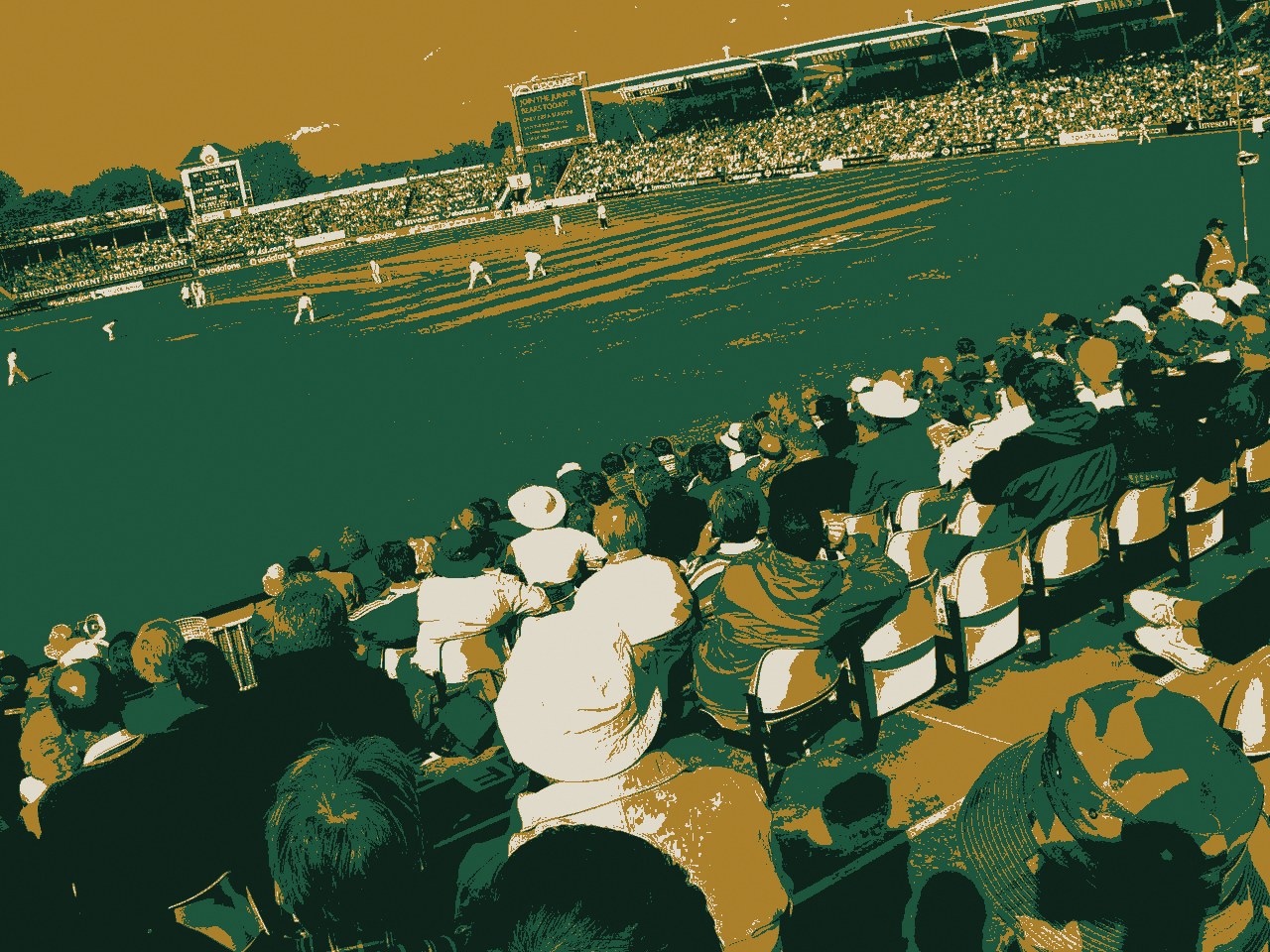
England made 407 in 79.2 overs. Marcus Trescothick scored 90 off 102 balls with fifteen fours and two sixes, and was part of an England side that were moving at more than five an over before lunch. Andrew Strauss made 48. Ian Bell lasted three balls for six. Vaughan himself made 24. Kevin Pietersen, in his first Ashes series, made 71 off 76 with a six; Flintoff made 68 off 62 with five sixes. Giles contributed 23, Hoggard 16, Harmison 17, Simon Jones 19 not out. The extras column had fourteen no-balls. Warne’s four for 116 was expensive by his standards; Kasprowicz’s three for 80 came with eight no-balls of his own. Vaughan noted the rate: “an amazing series for scoring rates: we scored more than 400 in less than 80 overs.” Flintoff’s 68, he added, had “a slight element of luck” – a hook at Brett Lee that he tried to leave and that still went for six – and that confidence went with him into the bowling. Australia replied with 308. Hayden was out first ball of the innings, caught by Strauss off Matthew Hoggard – “Instinctively as I walked out I said to Strauss to field on the drive and Hayden smacked it straight to him,” Vaughan wrote. Ponting made 61 and top-edged a sweep to Giles; Vaughan remembered “the celebrations told what it meant to Giles to get into the series.” Damien Martyn was run out by Vaughan for 20. Michael Clarke made 40. Langer ground out 82 before Simon Jones had him lbw. Gilchrist finished 49 not out. Flintoff took three wickets, Giles three, Simon Jones two. England’s lead was 99. It was, Vaughan said, “a day of reverse-swing for Flintoff and Simon Jones – an abrasive pitch and a still day, that really helps.”
That evening, and into Friday, Warne began the reply England feared. With the new ball late on the second day he bowled Strauss for the second time in the match. Strauss stepped outside his stumps and played no shot; the ball jagged back about a yard and hit leg stump. Wisden, ranking five moments from the match years later, put it among Warne’s best of the summer, short of the Gatting ball of 1993 but in the same conversation. Vaughan’s Telegraph memory of “that ridiculous legbreak which sneaked through his legs” is the same delivery.
Thursday afternoon: more than five an over
Once Ponting had bowled, the day belonged to England’s batting order in a way Lord’s had not allowed. Trescothick and Strauss put on 112 for the first wicket. Trescothick’s ninety came at nearly a run a ball. When Warne finally bowled Strauss, and Kasprowicz had Trescothick caught behind, Bell came and went for six off three balls, also caught behind off Kasprowicz. Vaughan was caught off Gillespie for 24. At 187 for 4 the innings could still have folded. Pietersen and Flintoff put on 103 for the fifth wicket instead. Flintoff’s sixty-eight included five sixes; Vaughan later joked that he “went to hook Lee, then to leave it, and it still went for six.” Gillespie had him caught behind. Kasprowicz removed Geraint Jones for one. Warne had Giles lbw for 23 and Harmison bowled for 17, and finally Hoggard lbw for 16, but Simon Jones’s unbeaten 19 took England past 400. The declaration was never needed. Australia had to bat to a total England had made in a day.
Friday into Saturday: Warne, and a target of 282
England’s second innings was a different match. Warne took six for 46. Lee took four for 82. Strauss, late on the second evening, was bowled by what Vaughan called “that ridiculous legbreak which sneaked through his legs.” On the third morning Lee removed Trescothick for 21, edged behind, and then bowled Vaughan for one, off stump out of the ground for the third time in the series. Hoggard, the nightwatchman, lasted 27 balls for 1 and edged to Hayden at gully. Pietersen’s first ball brought a shout for a glove down the leg side; Bowden shook his head. Pietersen then launched Warne for two sixes in an over, before falling for 20, sweeping, caught behind – “although replays show he might have been unlucky,” the BBC noted. Bell feathered Warne to Gilchrist for 21. Geraint Jones gloved Lee to Ponting at slip. England were 101 for 7 at that point, the lead 200, and Flintoff was already grimacing at a left shoulder that needed the physio, Kirk Russell, on the field.
Gillespie dropped Jones on two, a return catch. Giles edged Warne to Hayden. Harmison lasted one ball for a golden duck, caught at silly point off Warne. England were 131 for 9 when Flintoff was joined by Simon Jones. What they did next is the stand Vaughan still calls “the most crucial stand of my captaincy.” Flintoff launched Kasprowicz for six over mid-wicket off a no-ball, then another, to bring up his fifty; one Kasprowicz over cost eighteen. Lee was “unlucky not to have Jones lbw,” the BBC wrote, with a ball that swung late; Ponting came down to speak to Bowden. Flintoff crashed Lee over long-on and out of the ground. The fifty partnership came off 40 balls. Warne finally bowled Flintoff for 73, heaving, and finished with six for 46 and 599 Test wickets. England were all out for 182 – the figure on the ESPNcricinfo and CricketArchive scorecards, and on the BBC’s match pages – and Australia were set 282, which would have been a ground record chase at Edgbaston. Mike Selvey, on Test Match Special that afternoon, said Australia would claim they could chase anything, “but I don’t know they’ve ever done so against an attack like England’s on a pitch like this.”
Australia began the chase on Saturday afternoon. Langer and Hayden calmed their nerves, Vaughan wrote, until Flintoff produced the over he still ranks as the best of his captaincy. Australia were 47 without loss. On the second ball of the over Flintoff bowled Langer, inside edge onto the stumps. Ponting came in. There were lbw appeals, an outside edge, a no-ball; the last ball swung, and Ponting edged behind to Geraint Jones. Ponting later told interviewers it was the best over he ever faced; Wisden recorded the claim. “Fred bowled Langer and Ponting out, they couldn’t do anything about it,” Vaughan wrote. Hayden went for 31, flashing at Simon Jones. Damien Martyn drove Hoggard to mid-wicket. Katich wafted Giles to slip. Gilchrist flicked Giles to mid-on, where Vaughan had stationed “a big pair of hands,” and Flintoff held the catch. “Game over, we’re winning this,” Vaughan thought. Gillespie was lbw to Flintoff for a duck. Harmison then bowled Michael Clarke with a slower ball in the last over of the day – Wisden’s fifth memorable moment of the match. Australia closed on 175 for 8, Warne 20 not out, still 107 short. The England dressing room was cock-a-hoop again. The ball was reversing. The forecast for Sunday was the same.
Sunday morning: fifty-nine
It was not the same. The ball stopped reversing. The BBC’s ball-by-ball page opened with a ground “looking pretty full already, with home fans anticipating victory celebrations,” and a warning that Warne was in form and Lee was capable. Vaughan led the side out at 10.25am needing two wickets; Australia needed 107. Angus Fraser, writing in the Independent, said an England victory “had appeared to be a formality.”
Warne and Lee put on 45 for the ninth wicket. “Little did we know that Warne and Lee would bat out of their skin,” Vaughan wrote. At 10:50 Warne cut Flintoff for four to take Australia to 200 and himself to 34. At 10:55 a rising Harmison ball came off the high part of Warne’s bat and flew over the slips for four; the BBC called it “an extraordinary piece of cricket.” Lee drove Harmison to long-off. The target was down to 66. Giles came on for Harmison at 11:04, a move the BBC described as “something of a victory for the batsmen.” Four minutes later Warne stepped back and across to a Flintoff delivery that passed down the leg side and walked into his own stumps. He had made 42. Australia were 220 for 9, still needing 62. By all ordinary reasoning, England had won it.
Kasprowicz walked out to join Lee and survived a king pair. What they did next took 12.2 overs and 59 runs. At 11:12 Flintoff hit Lee on the elbow with a short ball; “Flintoff is in no mood to offer sympathy – he is on the verge of glory,” the BBC noted. At 11:25 Lee launched Giles to deep mid-wicket. At 11:27 Kasprowicz swung Giles high over mid-off and edged wide of slip for successive fours. The partnership was worth 29 and rising. Harmison returned, bowled a wide down the leg side for four byes, and Australia needed 20. Flintoff came back at the City End. At 11:46 he hit Lee on the left hand; Lee dropped the bat. At 11:55 Kasprowicz upper-cut him to third man and Simon Jones dived and could not hold on. “His head went down, but only temporarily,” Thompson wrote. Flintoff’s next ball was a no-ball that raced for four byes. Nine needed. Kasprowicz, looking back for i, remembered the noise dropping: the target had gone from 14 to nine. “All of a sudden it just went quiet. From all the noise, the energy, there was nothing. I remember thinking ‘Wow. Now we can win.’”
Fraser’s Independent account puts Harmison’s final over at about 12.10pm from the Pavilion End, with Australia three runs from a win that would have all but retained the Ashes. Lee then smoked a cover drive off Harmison that Kasprowicz thought had won it. “Brett has absolutely smoked it. People in Australia say they were up cheering at that point thinking we’d done it. Then, all of a sudden, you see it go straight to Kevin Pietersen in the deep. One run.” The BBC had Lee needing four after a single at 12:08. Kasprowicz was on strike. Harmison ran in again.

Lee then smoked a cover drive off Harmison that Kasprowicz thought had won it. “Brett has absolutely smoked it. People in Australia say they were up cheering at that point thinking we’d done it. Then, all of a sudden, you see it go straight to Kevin Pietersen in the deep. One run.” Kasprowicz was on strike. Harmison ran in again.
Two runs, and a glove
The ball was short. Kasprowicz’s hands went up. The ball brushed the glove, and Geraint Jones took the catch low to his left. Billy Bowden’s finger went up. England had won by two runs. “What a finish to one of the greatest matches in history!” the BBC’s ball-by-ball page said at 12:09.
Then the replays started. The BBC noted the same day that “TV replays showed that the dismissal should not have been given, Kasprowicz taking his lower hand off the bat before ball hit glove.” Law 6 requires the hand to be holding the bat. Mike Selvey, writing in the Guardian a week later, said cricket might have been done a service if Bowden had had Channel 4’s 70-frames-a-second replay and reprieved him. Bowden himself, speaking to the Independent during the series, was candid: the Edgbaston decision “when he gave Michael Kasprowicz out caught behind when his hand was just off the bat was probably not out.” Kasprowicz has never stopped saying the same. “If we’d had DRS, that would have been picked up, and the MCC laws of cricket say that’s not out.”
There is a counter-argument that belongs in the same paragraph. Wisden, revisiting the match, notes that Kasprowicz might already have been out lbw to Flintoff 10.2 overs earlier, off his third ball, with Australia still needing 55. On a Sky Sports watchalong, Rob Key called it “hitting middle of middle.” Michael Holding, on the original commentary, said “it couldn’t be plumber.” Bowden kept his finger down that time. The match, like most close ones, is a ledger of decisions that went both ways.
Fraser’s Independent report, filed when the stands were still loud, has the scene without the later law seminar. Kasprowicz “looked down the wicket hoping the umpire, Billy Bowden, would not give him out but he saw the finger rise and sank to his knees.” Geraint Jones, who had “taken some stick” after drops at Lord’s, “started gesturing to a section of Australian spectators who had been goading him, while the rest of the team ran around like headless chickens.” The photograph of Flintoff and Lee was already forming on the other side of the pitch. The ledger, even then, had two columns.
What the winners and losers said
Flintoff, named man of the match, told Channel 4: “We’ve taken a lot of heart from this.” Asked whether England could now win the Ashes, he said: “We’ve got to!” Vaughan told the BBC that “most of our guys thought the game had gone.” In the Telegraph years later he was blunter about what the two runs meant: “I knew that if they had got over the line, it would have been Ashes over. We now knew we could win.” Ponting, for his part, gave the line Thompson recorded on the day: “Might have been a different story if it had been McGrath batting out there.”
Lee was the man Flintoff went to. Kasprowicz was the man nobody went to. “In that moment, I’m reflecting and I’m thinking, ‘could I have played that differently?’ And I’m not sure you can.” Asked much later whether he is glad it ended as it did, he said it was the first time he had been asked. “I think maybe yes. It was good for cricket, and if we’d have won that Test, it would have been forgotten. It would have just paled into all the other awesome wins by the Australian cricket team.” A stranger in a Delhi hotel lobby once thanked him for “single-handedly saving Test cricket.” Kasprowicz pointed out that the single hand in question had been off the bat.
The numbers the clock keeps
The CricketArchive scorecard is the spine. England’s first innings lasted 356 minutes and 79.2 overs. Australia’s first lasted 346 minutes and 76 overs. England’s second lasted 249 minutes and 52.1 overs. Australia’s second closed, on the third evening, at 175 for 8 after 43.4 overs, and finished on the fourth morning at 279 in what the live pages treat as a single prolonged session of nerve. Player of the Match was Flintoff: 68 and 73 with the bat, three wickets in the first innings and four for 79 in the second. Lee’s 43 not out and Kasprowicz’s 20 will not be remembered as great innings in the ordinary sense. They are why the match is remembered at all.
Close of play on day one: England 407 all out. Close of play on day two: England 25 for 1 in the second innings, Trescothick 19, Hoggard nightwatchman on 0. Close of play on day three: Australia 175 for 8, Warne 20 not out, 107 still required. The fourth morning lasted a little under two hours of playing time and felt, to everyone who has written about it since, like something longer. Vaughan’s “it only takes one ball” was the captain’s refrain while Lee and Kasprowicz were cutting the target down; Harmison’s short ball was the one ball. Between those two sentences sits the whole of Edgbaston 2005.
Three days later the sides met at Old Trafford. The recovery time, the BBC noted on the Sunday, was almost nothing. What England took north was not only a level series but a private knowledge that they had nearly thrown a winning position away and had held their nerve anyway. “While the England of old could have easily thrown away this match, today’s England showed that they have the stomach to fight,” Thompson wrote in her Cricinfo bulletin. “Crucially, the series is still live. Battle will recommence at Old Trafford in four days. Catch your breath while you can.”
Close of play, day by day
The scorecard’s closes are the match’s backbone. Day one: England 407 all out. Day two: England 25 for 1 in the second innings (Trescothick 19, Hoggard the nightwatchman on 0). Day three: Australia 175 for 8, needing 107 more, Warne 20 not out. Day four morning: Australia 279 all out, England winners by two. Those four lines are not in dispute on the ESPNcricinfo or CricketArchive scorecards. Everything else in this piece — the glove, the photograph, the warm-up ball — hangs off them.
Why Edgbaston mattered
England went to Old Trafford three days later with the series level at 1–1. They would regain the urn. The summer is remembered as a whole – Lord’s, Edgbaston, Old Trafford, Trent Bridge, The Oval – but Edgbaston is the hinge. Before it, Australia had the spearhead and the lead and the habit of winning. After it, as Vaughan put it, England knew they could win. The scorecard keeps the match as 407, 308, 182, 279. The clock keeps something odder: a Saturday evening that looked finished, a Sunday morning that refused to be, and a single ball that still divides people who were watching the same replay.
The BBC, on the day, reached for Headingley 1981: the last time England had come from behind to level an Ashes series, they had gone on to win 3–1. The rhyme was deliberate and, as it turned out, roughly right. Old Trafford was drawn with Australia nine down; Trent Bridge was won by England; The Oval was drawn with the urn coming home. None of those later Tests makes sense without the two runs at Edgbaston. Vaughan’s line about the Ashes being over if Lee and Kasprowicz had got across the line is not hindsight dressing. It is what the captain thought while the ball was still soft.
What I keep coming back to is the two pictures that do not fit together. Flintoff and Lee, the arm around the shoulder, the image that went round the world. Kasprowicz on his own, replaying a ball he is still not sure he could have played differently. Edgbaston 2005 is both of those things at once: a match England won by the width of a glove, and a match Australia lost by the width of the same glove, and a morning on which 59 runs from the last pair nearly made the arithmetic come out the other way. The scorecard keeps 407, 308, 182 and 279. The clock keeps the hour between Warne’s hit-wicket and Harmison’s short ball, when a formal victory became a knife-edge and then a photograph. The Ashes turned on it. So did the photograph. The man who was not in the photograph has had twenty years to decide whether he minds.