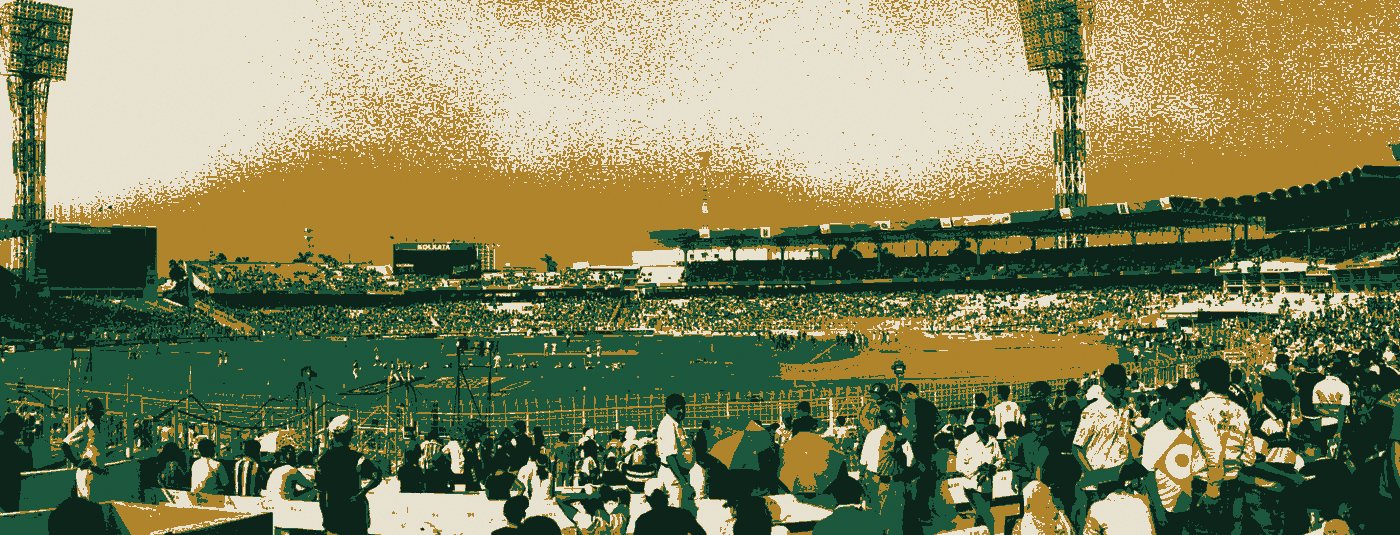


The Indian team’s luggage left the hotel without them on Wednesday 14 March 2001. The players had been told, Sportstar’s Vijay Lokapally wrote twenty years later, that their departure for Chennai had been brought forward by a day, so they left their bags outside their rooms before going to Eden Gardens, and the bags were collected and taken to the airport. It was the sort of arrangement you make when you expect a match to be over. Lokapally was in the press box, and he was honest about it: “it would be a lie if I said we were thinking of an Indian win.”
The match did not end. “All our bags were still at the airport when the day’s play ended,” the substitute fielder Hemang Badani told him, and the players, who had spent the day watching two of their team-mates bat for ninety overs without losing a wicket, went back to their rooms and found, in Lokapally’s words, that they “had no clothes to change.” The following evening, after the Test had ended in a way nobody on the Wednesday could have imagined, the team went to the airport properly, and V. V. S. Laxman has never forgotten the flight. “All of the passengers stood up and gave us a standing ovation,” he told Fox Sports Australia. “That sight I can never forget.”
Between the bags and the standing ovation is the most celebrated Test ever played in India, and it is usually told as a scorecard: 445, 171, 657 for 7 declared, 212; India by 171 runs; 281, 180, 376; a hat-trick; a streak of sixteen Australian Test wins ended. All of it is true, and none of it quite explains why the match feels the way it does. That comes from the hours. Kolkata 2001 is a Test you understand by the clock, so this is the story of five days kept session by session, from the Cricinfo scorecard: what the evenings did, what the lunches did, and what happened, again and again, after tea.
It is now 25 years since, and the anniversary pieces arrived in March: Laxman and Dravid together in the Hindustan Times, a Sportstar special called Miracle at Eden, Sourav Ganguly telling the Telegraph he plans a reunion at the ground. This piece draws on those, but leans hardest on the people who wrote the first drafts in March 2001 with the match still going on.
Sunday: sixteen in a row, and one wicket by tea
Australia arrived in 2001 with a streak that looked like a law of nature. They had won 15 Tests in a row, and the first Test in Mumbai made it 16, by ten wickets inside three days. They had not won a series in India since 1969, and Steve Waugh called it the “final frontier”. In Out of My Comfort Zone, as Andrew Ramsey quoted it on cricket.com.au in 2021, Waugh explained why he had chosen to bowl first in Mumbai: “we had won 15 Tests in a row. That statistic meant we’d bowled out the opposition on 30 consecutive occasions, so we knew how to get the job done.” Adam Gilchrist had made a century from 84 balls there, in his first Test in the subcontinent.
India were without Anil Kumble, who was out after shoulder surgery, and the newly appointed captain, Ganguly, had to find a spinner. He told the Telegraph this March that after Mumbai “the selectors were after my life to drop Harbhajan. But I had noticed the spark in him.” Harbhajan Singh had taken four wickets in Mumbai and remembers the feeling as survival: “I was fighting for survival in Mumbai. The four wickets gave me all the confidence that I needed. At least they won’t drop me, and that was a pretty nice feeling going into the Test at Eden Gardens.”
Australia won the toss on Sunday 11 March and batted, and for two sessions the day was theirs. Hayden and Michael Slater put on 103 for the first wicket, and at tea Australia were 193 for 1 after 53 overs, Hayden 97 not out. “Australia had lost just one wicket in the first two sessions,” Harbhajan told The Hindu. “They were just belting us.” That evening he told Rediff’s Rifat Jawaid, in Calcutta, that “when the Aussies were hitting me all over the ground, I had begun feeling low.”
Hayden went a few balls after the interval, three short of his hundred. Then the evening did what the afternoon had not. Between tea and the close Australia lost seven wickets for 98 runs, and in the middle of it came the first hat-trick by an Indian bowler in a Test match. Ponting was lbw. Gilchrist was lbw. Shane Warne played at the third ball and Sadagoppan Ramesh took the catch at short leg, which went to the third umpire; when it was given, the BBC reported, the crowd went into a frenzy.
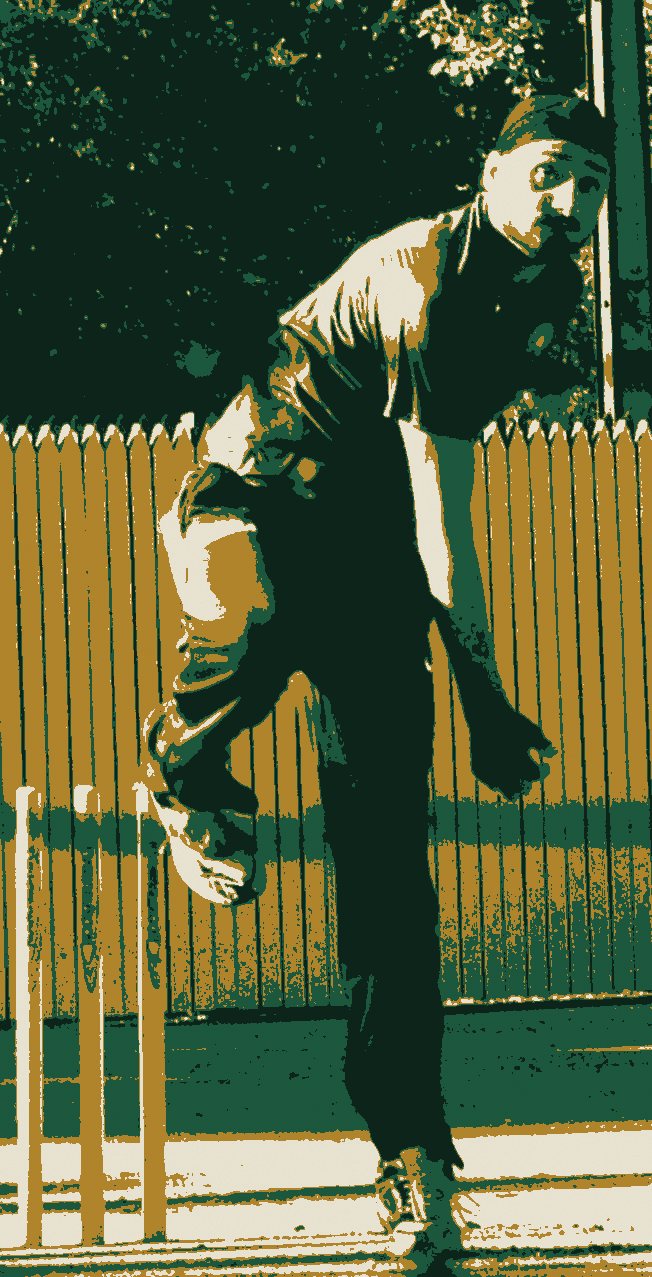
What Harbhajan remembers of those three balls changes with the year you ask. On the day, Rediff had him saying he flighted one to Ponting, who “misjudged it and ended up throwing his wicket,” and that Gilchrist “too failed to read the flight and played back.” Twenty years on, he told the Sydney Morning Herald’s Jon Pierik that Gilchrist “was looking for the ball to spin but it didn’t spin – it skids on from the wicket and hits his pad. I rushed him.” Everyone, the bowler included, gives the credit away. “You don’t bowl to take a hat-trick,” he told The Hindu. “It happens. It was a team hat-trick.” And to the SMH: “I feel that hat-trick as much as it belonged to me, it belonged to Sadagoppan Ramesh as well.”
Gilchrist, the middle victim, is warmer about it than you might expect. “It was a hat-trick and he did it,” he told Fox Sports in 2021, adding that he was loath to relitigate the lbw because “every time I do and it hits social media Harbhajan starts calling me a whinger and a loser again.” Dravid, looking back this March in Sportstar, noticed a pattern that matters for the rest of this story: “It is hard to explain Australia losing seven wickets in the final session on both day one and day five. It was one of those things.”
Australia closed on 291 for 8.
Monday: “He must be crazy”
Waugh took his score from 29 to 110 on the Monday morning, his first Test hundred on Indian soil, and was the last man out; Australia were all out for 445 in 131.5 overs. Anand Vasu, writing for Cricinfo on the Wednesday, said Waugh was the first to acknowledge what the ground does to a visitor who succeeds there. “The atmosphere is that of a bull ring rather than a quiet cricket ground,” Vasu wrote. “There’s no Long Room, there are no WG Grace Gates and there is no Father Time on the weather vane looking down at a match in progress.”
India’s reply was Sunday evening again, from the other side. Glenn McGrath bowled 14 overs, eight of them maidens, and took 4 for 18. At tea India were 32 for 1 after 11 overs; by the close they were 128 for 8, seven wickets for 96, the mirror of Sunday’s seven for 98. Laxman, at No. 6, was 26 not out.
The best account of that evening comes from Venkatapathy Raju, who batted with Laxman in the first innings and told it to ESPNcricinfo’s Nagraj Gollapudi for The Cricket Monthly in 2016. “At the end of the second day we were 128 for 8, and frankly, I had given up any hope of us saving the Test,” Raju said. The team manager, Chetan Chauhan, and the selector Madan Lal sat down with Raju and Laxman in the dressing room and told them stories of how India had saved Tests before. “Laxman, who was listening intently, suddenly got up and said: ‘We have a good chance to win the match.’ I thought to myself: ‘He must be crazy.’”
He was not crazy, or not entirely. But Laxman should not have been there at all.
A back and a fever
In the first net session in Kolkata, three days before the match, Laxman’s back seized. He tells it in his autobiography 281 and Beyond, written with R. Kaushik, and the extract reproduced by Bengaluru Review has him begging the physio, Andrew Leipus: “Tell me you can fix this Andrew.” He adds: “There was a salty taste in my mouth. I didn’t even realize I had started to cry.” He told The Hindu’s K. C. Vijaya Kumar that when he looked in the mirror, “my entire upper body had tilted to the left-side.”
Leipus remembers it as the eve of the Test rather than three days before, but the picture is the same. “I told him, ‘Have a look in the mirror and tell me what you see,’” he told Gollapudi in The Cricket Monthly. “If VVS was a fast bowler he would have never played that match.” Laxman told the Khaleej Times that the captain and coach agreed to play “a 60 per cent fit Laxman in the eleven.”
Dravid was ill as well. “His injury and my sickness – it was strange how things worked out,” he told Sportstar this March. He had a fever, missed practice, and had “not even been to Eden Gardens because I was in the hospital.” He passed a fitness test on the morning of the match.
Tuesday morning: five minutes
The last two Indian wickets fell early on the Tuesday, and India were all out for 171 in 58.1 overs, Laxman the last to go for 59. The lead was 274, and Waugh had a decision to make. It is the most argued-over follow-on in the history of the game, and the people who made it do not agree on how.
Waugh’s version, in Out of My Comfort Zone, as Pierik quoted it in the SMH: “It was a decision we discussed as a team but I was extra keen to keep them pinned down and keep the momentum going.” Gilchrist, the vice-captain, remembers a consultation and a vote. “I think I recall Steve asking the bowlers how do you feel,” he told Fox Sports. “And I think generally that it was overwhelming, a unanimous vote, let’s go. Let’s nail them.” Michael Kasprowicz said the word in the dressing room was belief.
Warne remembers a different conversation. He told The Cricket Monthly that Waugh asked how the bowlers felt. “I said, ‘Mate, I think we just bat again.’ He says, ‘Umm, maybe, maybe, no, no, I think we should just bowl again.’ And I said, ‘Mate, you want to bowl? It’s hot out there.’ So anyway we decide to enforce the follow-on.” Hayden told the SMH: “Stephen had his point of view but Warney definitely had his point of view on it as well. He wanted to bat.”
The coach, John Buchanan, has told it more than once and the discussion has shrunk. He told The Cricket Monthly that “we had just five or six minutes to make the decision.” In 2021 he told the SMH it was “probably two-minute discussion,” and then gave the paradox at the heart of the match: “the only way India could get back in to the game was to make them follow on, because if we batted again, even if we batted poorly, they are chasing over 400 on a fourth-or-fifth-day wicket.”
So Australia fielded again, and in the Indian pavilion Laxman, the last man out, sat down to take off his pads. He remembers it in 281 and Beyond: “‘Don’t take your pads off, Lax.’ ‘Oh! Why, John?’ ‘you are going in at No.3’. My mind went blank.” It meant Dravid, who had been scratching for runs all series, dropped from No. 3 to No. 6, and the coach, John Wright, asked him while Laxman was still batting. “It hurt me a little bit in terms of my pride and ego,” Dravid told Bal in The Cricket Monthly in 2014. “I thought, ‘Look, I can go out and play well too.’ But I didn’t say that to him.” This March he called it “a great decision by John Wright.”
Tuesday afternoon: twenty short
India batted for the rest of the day. Ramesh and Shiv Sundar Das put on 52, Das hit his own wicket off Jason Gillespie, and Tendulkar, for 10, edged Gillespie behind. India were 115 for 3, and at tea 122 for 3 after 40 overs, Laxman 31 not out. After tea Ganguly stayed with him for 117 and was the only man out in the evening session. V. V. Krishnan, the Sportstar photographer, thought it worth noting: “India bucked the trend of a cluster of wickets falling after the tea break.” By the close India were 254 for 4 after 75 overs, Laxman 109 not out, off 166 balls, and Dravid, who had walked in at the fall of Ganguly, was 7.
They were twenty runs short of making Australia bat again, and the dressing room across the way had got ahead of itself. “We buzzed around the changeroom at Eden Gardens,” Waugh wrote in Out of My Comfort Zone, “imagining what the celebration was going to be like after we won our 17th Test in a row.” Slater had a box of Cuban cigars, Hayden told the SMH, that they were going to smoke when they had won. “He did have the cigars out on the morning of day four,” Gilchrist told Fox Sports. “‘Tonight’s the night boys.’”
The third evening was quiet for the two men who would define the next. Dravid had dinner with Saba Karim, who was living in Calcutta, and his wife Rashmi, and went to bed early. Laxman’s memory is the walk off. As they went back, with Laxman on his hundred, “Rahul told me, ‘I am so proud about the way you batted the whole day.’”
Wednesday: the longest day
The fourth day began with the second new ball, and the first test was to survive it. Laxman told Fox Sports that he and Dravid sat on the balcony before play and “challenged ourselves whether we can bat the whole day without losing a single wicket.” They scored 51 in the first hour, the BBC reported, unfazed by the new ball, and Dravid, who had been bowled by Warne in the first innings, hit three consecutive boundaries off him. Dravid had his fifty before lunch, which India reached on 376 for 4 after 104 overs, Laxman 171.
Warne bowled 34 overs and took one wicket for 152. He told The Cricket Monthly how it looked from his end: “I was bowling in the footmarks and Laxman was hitting the same ball through cover or whipping it through midwicket. It was so hard to bowl then.” Ian Chappell later called it “the best playing of spin bowling I’ve seen.” Dravid, who had the best seat in the house, did not try to copy any of it: “When you see those kinds of shots, you tell yourself, ‘Don’t copy this.’”
After lunch Laxman went past his own best, 167 at Sydney, with an off-driven four off Warne, and then past 200, off 304 balls. Dravid reached his ninth Test hundred, in his 42nd Test, with a four off Gillespie. Somewhere in the afternoon came Sunil Gavaskar’s 236 not out. Vasu’s report is the best record of what the ground did: “When he surpassed Sunil Gavaskar’s mark of 236, which the little master made against the fearsome West Indies at Chennai more than 17 years ago, there was a colossal roar in the stands. In the press box however, there was a hush in some sections, as many old timers were visibly saddened by the fact that Gavaskar’s record had fallen.” Laxman, asked about it afterwards, said: “The 237th run was the most important run of the innings. It overshadowed all the shots that I played.”
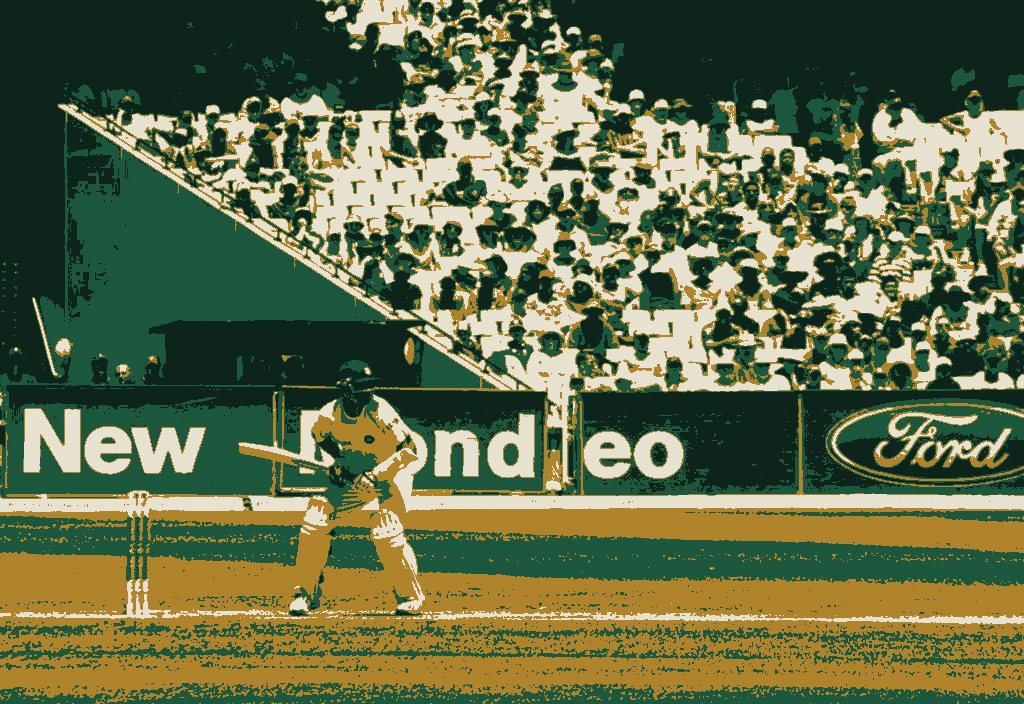
Nobody can agree how many people were there. “One of 50,000 odd people crammed into the stands,” Vasu wrote that evening. Lokapally, in Sportstar twenty years later, said 100,000 inside the ground and another 100,000 outside. The SMH’s retrospective said 90,000. Kasprowicz, who was fielding, offers no figure and says only that it was the loudest crowd he has played in front of, “an incessant noise, a hum,” and that “you’d be hit by something on the back and you’d turn around there was a battery on the ground or a stone, and you’d turn around and be staring at the crowd and all these people would be smiling at you – and that would include the police officers.”
Waugh used nine bowlers: his brother Mark for 18 overs, Ponting for 12, Hayden for six, with Slater and Langer rolling an arm. Gilchrist, keeping wicket to all of it, looked for any escape. “We went through our top 10 movies, songs, sporting events, we went through every category to try and keep ourselves engaged because it just went on and on and on,” he told Fox Sports. In a twentieth-anniversary column published by Daak Bangla, he wrote that “I do not recall another day of wicket-keeping where no wicket has fallen, and I am truly grateful for that.” Gillespie put it more bluntly to The Cricket Monthly: “I was pretty sick of the sight of Mr Laxman.”
The two batsmen were falling apart in their own way. “The crucial phase was when Rahul started cramping,” Laxman told Bal in The Cricket Monthly. “He had a fever, coming into that game. He was on antibiotics.” Leipus’s equipment was a pair of towels, cut, dipped in iced water and wrapped round their necks: “There were no ice vests back then.” By tea Dravid wanted only water and a cold towel. Even so, he told Bal, it was around tea that he turned to Laxman and said: “You know, we could be in the middle of something special here.”
At tea India were 491 for 4 after 133 overs, Laxman 227, Dravid 106. A last session of 32 overs remained, and here, Laxman says, the real examination came. “I had a decision to make: whether to go for my triple-hundred or to achieve our goal with which we had started the day – not losing a single wicket.” His back was going; Dravid took most of the strike, and Laxman held back. Dravid remembers “a little bit of a cool breeze” towards the end of the day, and the fear that “all the good work could have got undone in this last session.”
They did not lose it. At the close India were 589 for 4 after 165 overs, Laxman 275 not out and Dravid 155 not out, an unbroken stand of 357. “No wickets were lost on the day, 335 runs were scored, not a single catch given and nine bowlers were used,” Vasu wrote. It was the one day of the five on which the interval changed nothing: no wicket before tea, none after it.
It was a sapping effort, both of the physique and the mind. However, the Laxman-Dravid duo conquered all including the Australian bowlers.
Cricinfo’s staff reporter caught the two of them at the press conference that evening. Dravid had celebrated his hundred with a gesture towards the press box, and Vasu had noticed: “The young man was obviously upset by something written earlier.” Dravid said it was not anger. “I would rather say that we were disappointed. Everybody was writing us off as a team.” Ganguly said, “This is the best knock I have seen both of them play,” and the coach, Wright, said: “They demonstrated that they are champion cricketers. They have inspired the entire team.”
Then came the drips. “I needed IV fluids straight after the game in the dressing room,” Dravid told Bal in The Cricket Monthly. Leipus has the funniest version: “One was on the physio table and one was on the lunch table. It really was the Wild West back then.” Laxman told the Telegraph’s Lokendra Pratap Sahi in 2010 that he could have done without it: “I suppose the medical staff didn’t want to take a chance with me and put me, too, on saline!”
What the pair did next is told differently by different sources. Fox Sports has them both at Ganguly’s house for dinner. Dravid told Bal in The Cricket Monthly in 2014 that he went “for a short time” and took a car back early; this March he told Sportstar he was “too tired to step out.” In 2014 he added what mattered: “You also knew, though, that the Test match hadn’t been won and that if we did win, it would be really special.”
Thursday: after tea
Laxman had told reporters that his aim was 300, though “that is a secondary aim. The first aim is to guide the team to a victory.” He added six runs. He slashed at a short, wide ball from McGrath and was caught by Ponting at gully, after 631 minutes and 452 balls. In 281 and Beyond he writes of the stroke without regret: “I walked off the park immensely satisfied. I hadn’t missed out on 300 by 19 runs; I had made 281.” Dravid was run out for 180, in a mix-up with Zaheer Khan that Cricinfo’s Woorkheri Raman wrote “brought about his end.” The stand was 376. Of the ovation for Laxman, Vasu wrote: “If this were the Lal Bahadur Shastri Stadium in Hyderabad, his home town, the cheers wouldn’t have been louder or the ovation more heartfelt.”
India declared at 657 for 7, after 178 overs and 737 minutes. Dravid has a theory about the size of it. The runs, he told the Times of India this March, “in some ways were a backhanded compliment to the Australians because they were such a strong team that we believed that we had to put up so many runs on the board.” Australia needed 384 in a little over two sessions, and for a long time it looked like a draw. At lunch they were 24 for no wicket, Lokapally recalled. In the second session they added 137, and at tea they were 161 for 3 after 43 overs, Hayden 59 and Waugh 23. Hayden and Slater had opened with 74 in 23.2 overs.
One of Lokapally’s colleagues in the press box was not convinced. “One of us, not willing to cancel his ticket,” Lokapally wrote, “had left the stadium at tea to take a train back to Delhi. He was convinced the match won’t last the distance.” He surely, Lokapally added, “missed the match of his life.”
What happened after tea took 25.3 overs. Waugh, who had called for a tempered approach, was dropped at backward short leg by Ganguly, and Badani, on as Ganguly’s substitute, held the next chance. “My job was to sledge,” Badani told Lokapally. “That’s what Sourav had instructed me.” Waugh was out at 166. The Independent’s Associated Press report had Harbhajan removing Waugh and Ponting in the same over; then Gilchrist was lbw to Tendulkar off the first ball he faced, a king pair, and Hayden and Warne followed. Australia were 174 for 8. “One more wicket — of Adam Gilchrist out first ball — suddenly opened up the possibility of an Indian victory,” Lokapally wrote in Sportstar, and he opened two windows on his laptop, “one in anticipation of India winning.”
It still took a while. Gillespie and Kasprowicz put on almost ten overs for the ninth wicket, and Kasprowicz remembers them “blunting it. Hanging in there.” Then Harbhajan changed ends and in the first over from the new end hit McGrath on the pads. “I remember the finger was going up with the appeal.” Australia were all out for 212 in 68.3 overs, seven wickets for 51 after tea, and India had won by 171 runs. Vasu noted a “mad rush for souvenir stumps.” “Frankly, more than my innings and our partnership,” Laxman told the Telegraph, “the most beautiful moment in that Test was when Glenn McGrath got out (to Harbhajan Singh) and we won an unbelievable match.” Harbhajan finished with 13 for 196. He kept “the whole kit bag, a stump, the ball, and even the worn-out socks with holes in it,” and a letter of appreciation from the prime minister, Atal Bihari Vajpayee.
What the losers said
Waugh’s press conference still has the shock in it. “I must give full credit to the Indians who fought back into the game brilliantly,” he told Rediff. “Once India got 300 runs lead, they were always in the driving seat. I knew we were never gonna win the game.” Cricinfo had him philosophical: “A loss is bad. But then that is not the end of the world. Life goes on.” “India batted us out of the match,” he said, and of the Test, “even then the charm of this particular game will remain with me.” In Vasu’s match report he called Laxman’s 281 “some of the best batting I have ever seen.” Mark Waugh was blunt about what it was like: “It was a setback, to lose from that situation it’s not going to happen many times for a quality team.”
It was only the third time in Test history that a side asked to follow on had won. The first was at Sydney in 1894-95, the second at Headingley in 1981, and Australia were the beaten side each time; Waugh joined Jack Blackham and Kim Hughes as the only captains to lose after enforcing the follow-on. Headingley is a Journal essay on this site: the Test England had already checked out of.
The Australian writers were generous. After the series was settled at Chennai, the NZ Herald gathered what they said. “No shame lay in this defeat,” wrote the SMH’s Peter Roebuck. “Has there ever been a better test series?” asked Robert Craddock of the Daily Telegraph. The Australian’s Mike Coward said the defeat ended the debate over whether Waugh’s team was the greatest ever, since it was not, “but for mental strength, physical courage, self-belief, strength of character and resourcefulness it may well be the greatest of them all.”
Why Kolkata mattered
Dravid’s answer is the clearest. Before Kolkata, he told Bal in The Cricket Monthly, “I had already played about five years of international cricket but I didn’t have a match-defining performance.” After it, “irrespective of what you did from there on in, you would always be recognised and remembered for it.” It was bigger than the two of them. “We had just got a foreign coach; that probably would have changed. We would probably have had to rebuild and restart.” Laxman, in the same interview: “I think the mindset of the entire team changed. After that, when we were in similar situations, we always thought of what we had done in Kolkata.” Ganguly was more direct, at the Kolkata launch of Laxman’s book in 2018, as Times Now reported. “It should have been 281 and beyond, and saved Sourav Ganguly’s career,” he said. “If he had not scored 281, we would have lost the game.”
The Australians learned something, though less than the legend says. Kasprowicz thinks the Test “changed cricket in a lot of ways”, as teams second-guessed the follow-on. Ramsey checked it on cricket.com.au in 2021 and found a myth: in the 30 years before Kolkata the follow-on was enforced 89 times in 852 Tests, and in the 20 years after, 98 times in 876. Waugh enforced it in all seven later Tests where he could, including at The Oval five months later. Ponting and Gilchrist, who were both in Kolkata, enforced it only four times in 14 chances, and Gilchrist has said he was “mentally scarred” by the king pair.
What I keep coming back to is the clock. The scorecard keeps this Test as 281 and 180, 657 for 7 and 212 all out. The clock keeps it differently. On the Sunday, after tea, Australia lost seven wickets for 98. On the Monday, after tea, India lost seven for 96. On the Tuesday, after tea, they lost one for 132. On the Wednesday, nothing for 98. On the Thursday, Australia lost seven for 51. On four of the five days the match moved after tea; the fifth, the Wednesday, was the day on which it refused to.
Dicky Rutnagur found the line for it in the Wisden Almanack. Laxman, he wrote, “kept the jaws of defeat wrenched apart until they ached and became too weak to snap.” By the end, “it was India whose nostrils were filled with the scent of victory.”
Lokapally has the last word on how it felt outside the ground. “The walk back to the hotel after finishing work at the venue took unduly long as I made my way past the boisterous celebrations,” he wrote. “But I loved it, having become part of Eden’s history.” And that evening, on the flight to Chennai, the passengers stood to applaud a team that had spent five days finding out how long an afternoon can be.